<?xml version="1.0" encoding="UTF-8"?>
<feed xmlns="http://www.w3.org/2005/Atom">
  <title type="text">Salt River Stories</title>
  <updated>2026-04-17T19:35:33+00:00</updated>
  <generator uri="http://framework.zend.com" version="1.12.20">Zend_Feed_Writer</generator>
  <link rel="alternate" type="text/html" href="https://saltriverstories.org/"/>
  <link rel="self" type="application/atom+xml" href="https://saltriverstories.org/items/browse?output=rss2"/>
  <id>https://saltriverstories.org/</id>
  <author>
    <name>Salt River Stories</name>
    <uri>https://saltriverstories.org</uri>
  </author>
  <link rel="hub" href="https://pubsubhubbub.appspot.com/"/>
  <entry>
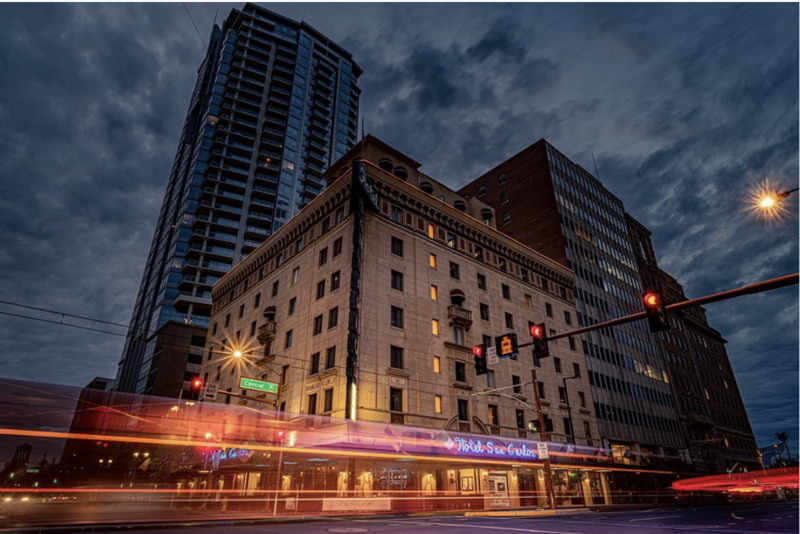
    <title type="html"><![CDATA[Hotel San Carlos: Phoenix&#039;s own &#039;woman in white&#039;]]></title>
    <summary type="html"><![CDATA[<p><strong><em>The Hotel San Carlos was built in 1928 as Phoenix's first luxury hotel.   Over a long history of catering to the rich and famous, San Carlos is also known for hosting ghostly visitors.  </p></strong></p><img src="https://saltriverstories.org/files/fullsize/5219d1b9ce7f4262593fc9a14db56065.jpg" alt="The Historic Hotel San Carlos" /><br/><p><span>The Hotel San Carlos was built in 1928. As a boutique hotel, it catered to the members of the Golden Age of Hollywood, including Marilyn Monroe, Clark Gable, Mae West, Gene Autry, and Carole Lombard. </span>

<span>However, soon after the hotel opened, tragedy struck. On May 7, 1928, a twenty-two-year-old woman named Leone Jensen jumped off the roof of the seven-story building, plummeting to her death on the street below. Before her death, she wrote a suicide note on the back of a hotel envelope to apologize for not paying the bill. "The coroner will attend to my bill and be sure all my clothes are packed," Jensen wrote. "I have five dollars, which he will get later tonight. Will that help any? My income was due on the 10th, but it wasn't to be." Patrolmen on Monroe Street reported hearing a scream and a thud at 2:45am. </span>

<span>While there has been much speculation about why Leone jumped, the most-repeated story involves a breakup with her bellboy boyfriend. In the years since, guests staying in that room have reported seeing a woman in white standing at the foot of their beds before vanishing.</span>

<span>Leone isn't the only ghostly resident of the Hotel San Carlos. Several witnesses have reported the specter of a little girl crying, and others have claimed to hear children laughing and running through the hallways and basement. Some have attempted to link the presence of ghostly children with the Native American grounds on which the hotel was built. It was also the site of a school, Little Adobe, which was closed in 1916.</span>

<span>For more information about the history of the Hotel San Carlos, click here: </span><a target="_blank" href="https://saltriverstories.org/items/show/92" class="editor-rtfLink" rel="noreferrer noopener"><span>San Carlos Hotel</span></a></p><p><em><strong><a href="https://saltriverstories.org/items/show/451">For more (including 5 images) view the original article</a></strong></em></p>]]></summary>
    <published>2022-10-28T03:51:13+00:00</published>
    <updated>2026-04-17T19:35:33+00:00</updated>
    <link rel="alternate" type="text/html" href="https://saltriverstories.org/items/show/451"/>
    <id>https://saltriverstories.org/items/show/451</id>
    <author>
      <name>Jennifer Schaper</name>
    </author>
  </entry>
  <entry>
    <title type="html"><![CDATA[The New Windsor Hotel : Once the Largest Hotel in the Arizona Territory]]></title>
    <summary type="html"><![CDATA[<p><strong><em>A resilient Victorian-era gem that has weathered the winds of change since its grand opening in 1893</em></strong></p><img src="https://saltriverstories.org/files/fullsize/5effa8ec7efc0e280247ecca55bafec7.jpg" alt="The Windsor Hotel" /><br/><p>The New Windsor Hotel is a survivor in downtown Phoenix. It was built in 1893 and had several remodels and name changes such as “The Windsor” and “The Sixth Avenue Hotel.” The hotel survived gentrification and was accepted into the National Register of Historic Places in 1985. The hotel is an example of Victorian style, modern aesthetics, and neon signs. The New Windsor Hotel is now used by the elderly because of its low budget accommodations. </p><p>A.D. Walsh built the New Windsor Hotel in 1893 on Sixth Avenue and Adams Street (546 W. Adams St.) Built in Victorian style, the Sixth Avenue Hotel became the largest hotel in the territory upon its opening. Walsh and his wife celebrated by hosting an Easter dinner in the hotel’s dining room. Mrs. Walsh had previously been a conductor of the Can Can restaurant in Tombstone and had built a reputation for herself as a restauranteer.</p><p>The hotel opened at precisely the moment that Phoenix began to transform. Phoenix had been a farming town with fewer than 5,000 people in 1893. There were more pool halls than lawyers, the new canal system had been freshly dug, and Phoenix had won the right to be the state capital from Prescott. The Sixth Avenue Hotel had become the place for dreamers moving to the Southwest to see if they could make their dreams come true. Within 25 years the population had grown almost ten times, and the region's growth continued to accelerate.</p><p>Architecturally, the hotel drew upon Victorian Era (1830-1910) styling, and The New Windsor introduced a dollhouse look with extravagant trims and loud colors influenced by Gothic architecture. The two-story brick hotel was renamed the Windsor Hotel in 1925 and later with the addition of another building, the New Windsor Hotel. The hotel was remodeled in 1935 adding a third story with a stucco façade (south and west walls) while adding a modern look by replacing some of the Victorian architecture. When additions were added in the 1950s the building was renamed the New Windsor Hotel. </p><p>The hotel lured guests with an unusual amenity in the 1930s that is evident on the "ghost sign" along the building's eastern facade. Along with the hotel's name, the words "air cooled" advertised the technology that so transformed the American South and Southwest after the 1930s. In 1937, the hotel took out a huge advertisement (almost half of a page), in the <em>Arizona Republic</em> touting its recent renovation. The hotel installed “Sno-Breze Dry Refrigerated Air Conditioning” and assured guests it was going to be a "cool summer." The ad claimed the air conditioning cut operating costs, lowered maintenance, and provided year-round comfort to customers. The hotel's clientele of permanent guests and transients no doubt appreciated the respite from the desert city's withering summer heat.</p><p>The New Windsor Hotel made the National Register of Historic Places in 1985 and is the only 19th-century hotel still operating in Phoenix. According to the National Register nomination, its period of significance was 1875-1899, the historical function is domestic, and current use was listed as a hotel. As repeated waves of development and gentrification washed over central Phoenix, the infrastructure from this early Victorian era gradually has disappeared. Those buildings that have survived have been adapted to new uses. For example, the Rosson House, built in 1895, became a centerpiece of Heritage Square. Likewise, the Evans House (1893), on West Washington Street, found repeated use by local government officials, including its present incarnation as the headquarters for Arizona's State Office of Historic Preservation. By and large, however, hotels like The New Windsor were razed, making way for new development, not all of it positive. For example, in the late 1980s, the Apache Hotel on Central Avenue was leveled and turned into a parking lot.</p><p>The Apache Hotel almost survived gentrification. It was first a Victorian-style building and transformed into an Art Deco style building in the 1930s before finally being demolished. </p><p>Additionally, as a single-room occupancy hotel, the New Windsor also has become one of the last remaining single-room occupancy hotels in central Phoenix. Single-room occupancy (SRO) hotels once flourished in central Phoenix, serving single men moving to the Valley to work, as well as the less affluent who could not afford more expensive rents. According to the Arizona Republic, in the early 1970s there were 36 single room occupancy hotels in downtown Phoenix, but this number had dwindled to just ten by 1985. By then, SROs had developed reputations for vice and criminality and were often dilapidated and located in the business district of big cities, where they provide affordable housing for the poor. Not only did soaring real estate prices and land speculation make it difficult for poor residents to find housing but it also created the conditions in which those older hotels were razed and replaced by new infrastructure.</p><p>In September 1989 a clientele of primarly older residents rented The New Windsor's 70 rooms. The rooms offered minimal necessities for nightly rates of $17, weekly rates of $61 or a monthly charge of $200. For these impoverished elders, the New Windsor Hotel may well have been a last resort. Most guests were men over forty, many of whom suffered from mental health issues, were disabled, and who lived alone. A number of them were divorced veterans who had served in Vietnam. Few women stayed at the hotel and the rooms were not big enough for families to stay. Some of the guests were seasonal, like other resort goers in the Valley. The New Windsor was occupied in the winter months and had vacancies in the summer months. </p><p>As of 2019, the New Windsor hotel remains a single-room occupancy hotel, reflecting an earlier era in Phoenix's history.</p><p><h6>edited 12/17/2019, MTT</h6></p><p><em><strong><a href="https://saltriverstories.org/items/show/410">For more (including 4 images) view the original article</a></strong></em></p>]]></summary>
    <published>2019-12-12T05:46:59+00:00</published>
    <updated>2026-04-17T19:35:32+00:00</updated>
    <link rel="alternate" type="text/html" href="https://saltriverstories.org/items/show/410"/>
    <id>https://saltriverstories.org/items/show/410</id>
    <author>
      <name>Hitsati Hudson</name>
    </author>
  </entry>
  <entry>
    <title type="html"><![CDATA[The Sahara Motor Inn: From Landmark to Law Building]]></title>
    <summary type="html"><![CDATA[<p><strong><em>Mid-century motor culture brought tourism to the Southwest.</em></strong></p><img src="https://saltriverstories.org/files/fullsize/08ee044a20482b83d0b32fe54548a35d.jpg" alt="The Sahara Motor Inn " /><br/><p><span>Built by an investment group led by prominent Phoenicians Marion Isbell and Del Webb, the Sahara Motor Inn opened in 1955. It became one of the signature hotels of the Ramada Inn motel chain during the 1960s. It served a generation of tourists to Phoenix. However, like other mid-century hotels, the property lost a bit of its luster. It became ripe for urban renewal efforts sweeping through central Phoenix. In fact, civic and university leaders reimagined downtown Phoenix by the opening years of the 21st century, including the blocks surrounding the hotel. Eventually, Phoenix and Arizona State University razed the building in 2010 over the objections of preservationists to create a new campus for its Sandra Day O'Connor College of Law. </span>

<span>The Sahara Motor Inn developed at the intersection of multiple trends in the mid-century, including the rise of auto culture, the rapid development of the Southwest, and new architectural styles. Webb, Isbell, and their partners built the hotel near the intersection of 1st Street and Polk Street, near Phoenix's central business district, and along Van Buren Avenue, the region's main artery along with Highways 60, 70, 80, & 89 flowed. The group hired Matthew E. Trudell to design the hotel. He used popular materials from the mid-century period, including red brick, colored art glass, tiles, floor and ceiling glass, cast-in-place concrete, and solid and patterned block. </span>

<span>The hotel included amenities that made it appeal to a wide array of visitors. The Sahara Motor Inn covered an entire city block, with 175 guest rooms, a bar area, a dining and lounge facility, and two terrace suites for holding meetings and parties. It even included two apartment penthouses. Shortly after its opening in the 1950s, the hotel attracted celebrities, partly because of its novelty and style and because one of its investors was a prominent performer of the period. Comedian George Goebel, who had a well-regarded comedy show on NBC that lasted from 1954-1959, invested in the hotel. Other celebrities stayed in the hotel as guests. For example, Marilyn Monroe resided in one of them while filming her movie <i>Bus Stop</i> in 1956. Based on William Inge's play, comedy-drama tells the story of a rodeo cowboy (played by Don Murray) who falls in love with a nightclub singer, played by Monroe. Both characters meet in Phoenix and attend a rodeo before heading out of town. </span>

<span>Interestingly, the Sahara emerged from a matrix of different business interests that coalesced in central Phoenix around the nascent motor hotel business. Mike Robinson created The Flamingo Inn in McAllen, Texas, in 1946. Along with a small group of investors from Chicago, they expanded the Flamingo into a chain with properties in Yuma, Phoenix, and Tucson in 1948. (Later, in 1962, Robinson started the Rodeway Inn Hotel Chain.) The group began working with Del Webb and Marion Isbell in the 1950s, using the name HiWay House Group, developing a series of hotels across Arizona, including the Sahara Motor Inn in downtown Phoenix. After the group's business interests diverged, Webb developed his own chain of Hiway House Hotels, as well as the Sun City retirement community. Robinson and Isbell, meanwhile, began developing the Ramada Inn motel chain. </span>

<span>The development of the Ramada Inn in the 1960s represented both the expansion and consolidation of the hotel industry, including the emergence of chain hotels. The idea behind chains was to create inexpensive and consistent lodgings that would profit off increasing numbers of automobile tourists and business travelers. Robinson recalled that he came up with the name Ramada, a Spanish word meaning "a place to rest by the side of the road." Robinson initially took the position of chairman of the board, and then Marion Isbell succeeded him in 1960, raising capital by taking the company public on the stock exchange. The influx of capital allowed Isbell to build the chain from 45 hotels in the American west to more than 500 motels in 45 different states.</span>

<span>Large hotel chains, such as the Ramada franchise, competed with local hotels, such as the hundreds located along Van Buren Avenue. As a result of economies of scale, attempts to homogenize the guest experience, and national marketing campaigns, hotel chains eventually undermined the business models of small, locally-owned hotels and supplanted them. With the development of the chain concept, formerly independent properties, such as the Sahara, lost their identity, becoming subsumed under the Ramada name. In fact, the Sahara became the "Sahara Ramada Inn," a title it held through a renovation in the 1970s, when it lost some of its distinctive design flair.</span>

<span>By the 21st century, the Ramada Inn downtown had lost its luster. It became vulnerable to the forces of development and redevelopment sweeping central Phoenix. Countervailing and somewhat paradoxical forces reshaped Phoenix's downtown. On the one hand, the sprawling regional development of Phoenix led to a lack of investment in the city center. At the same time, developers sought ways to revitalize the urban core. As these tensions and periods of recession saw central Phoenix witness incomplete redevelopment, older mid-century properties declined. Finally, in 2004, Phoenix and Arizona State University unveiled a plan for a "world-class" core of bioscience and commercial development. According to the <i>Arizona Republic</i>, the "faded pink stucco walls (were) greening in value," giving the owners a unique opportunity to profit from the land's redevelopment. Historic preservationists sought to save the building and re-use the mid-century materials. Still, their efforts were thwarted as the hotel was sold in 2010 to ASU for $5 million. Although ASU briefly used the property as a dorm, it demolished the Sahara Motor Inn to create a parking lot, which became the Sandra Day O'Connor College of Law site.  </span>
</p><p>-
<h6 style="text-align:right;"><!---edited 12/17/2019: mtt--></h6></p><p><em><strong><a href="https://saltriverstories.org/items/show/399">For more (including 6 images) view the original article</a></strong></em></p>]]></summary>
    <published>2019-12-05T02:03:06+00:00</published>
    <updated>2026-04-17T19:35:32+00:00</updated>
    <link rel="alternate" type="text/html" href="https://saltriverstories.org/items/show/399"/>
    <id>https://saltriverstories.org/items/show/399</id>
    <author>
      <name>Hitsati Hudson  </name>
    </author>
  </entry>
  <entry>
    <title type="html"><![CDATA[The Wigwam Resort: <span>How did a company guest house evolve into a world-renowned resort?</span><span></span>]]></title>
    <summary type="html"><![CDATA[<p><strong><em>From a modest six-room guest house in the middle of the desert, to a sprawling lusciously green oasis, the Wigwam's 100-year transformation is fascinating.</em></strong></p><img src="https://saltriverstories.org/files/fullsize/868d6cbee5e80ca1b9e897336df357e5.jpg" alt="Port Call at The Wigwam" /><br/><p>In Arizona hotels and resorts emerged as a cornerstone for tourism early in the twentieth century; they became pivotal in “selling the desert”. Sprawling landscapes with luscious green golf courses, rows of palm and citrus trees, swimming pools, tennis courts, and spas presented the allure of the Mediterranean, the beach, or the tranquil Midwest. Located in the heart of Litchfield Park, Arizona, just 16 miles from central Phoenix, the Wigwam Resort embodied these sensibilities and invited both American and international travelers for much of the twentieth century. </p><p>The Wigwam emerged during World War I, emblematic of how the war transformed global industrial supply chains. The war disrupted global supplies of Egyptian cotton for the Ohio-based Goodyear Tire and Rubber Company (Goodyear), which sought alternative sources of cotton for its tire-making process. In 1916 the company sent executive Paul W. Litchfield to Arizona to ascertain whether the location would be suitable for cotton production. After validating the area’s viability, Litchfield created the Southwest Cotton Company as a subsidiary to Goodyear. He purchased 16,000 acres of land for the cotton company and began hiring workers, clearing the desert, and growing cotton. Meanwhile, he established a seasonal homestead for his family, in addition to a company operations complex. The company operations area, called Litchfield Ranch, later evolved into the downtown district of Litchfield Park. The company even built a house for visiting executives. The Organization House, as it was called, was a six-room house, of adobe construction that travel-worn Akron executives stayed in when visiting the cotton fields. Indeed, in 1918, traversing the sixteen-mile stretch of open desert from Phoenix to Litchfield Ranch took nearly the entire day. </p><p>Over the following decade, the Organization House expanded to a capacity of twenty-four rooms and then expanded again to a guest capacity of sixty-six. On Thanksgiving day, 1929 the Organization House opened to the public under the new name of The Wigwam Guest Ranch. At that point, Goodyear also had finished construction of a nine-hole golf course, and the improving infrastructure made it possible for people to travel into the desert to experience its exotic comforts. The seasonal resort operated from December to May which allowed wealthy families to enjoy the desert while avoiding the grueling summer heat. The Wigwam offered many opportunities to spend time on the 17,000-acre ranch from golf to hiking and swimming to lounging in the desert sun, even rides in company stagecoach or the Goodyear Blimp. The Wigwam maintained a steep rate for the time period, and all of the revenue went straight to Goodyear as the property and resort owner. </p><p>World War II transformed both Goodyear’s business and how it used the Wigwam. The Goodyear Company held a significant number of government contracts for war effort production, especially related to the manufacturing of military parts and equipment. Also, the company closed the Wigwam to the public and opened all of its rooms to Army fighter pilots stationed at Luke Field, later Luke Air Force Base. </p><p>Following the war, the Wigwam resumed its public resort operations and continued to expand both in building size and recreational activities. The nine-hole golf course became an eighteen-hole course. During the 1950s two more eighteen-hole courses opened and golfers from around the nation flocked to the Wigwam. The golden age of the Wigwam spanned from 1950 to 1986. </p><p>During the golden age, the resort extended its season to October through May and continued to expand its amenities and the luxurious environment that made it so popular. During the 1960s, Goodyear transformed its business in Arizona for multiple reasons, including an industry-wide shift away from using cotton in tires. Goodyear then closed its farming operation and transformed its holdings into a land development and home construction business. Goodyear pursued a series of pre-planned communities surrounding the Wigwam, which evolved the landscape into modern-day Litchfield Park. </p><p>The company abandoned Arizona completely in 1986 when it sold its remaining 13,000 acres, which included the Wigwam, to the Suncor Development Corporation at a cost of $221 million. Suncor opened the resort year-round for the first time since its construction in 1918. However, they sold the resort after four years to a Japanese investment firm, Kabuto, for $70 million. Kabuto invested $13 million into expansion which added 90 more guest rooms and a series of conference and event halls. In 2009 the Wigwam switched hands again. The JDM Partners, a local Arizona owners group, sought to restore the Wigwam to its glorious past with over $7 million in restorations and renovations. The Wigwam still operates today. </p><p>The Wigwam Resort currently offers 331 guest rooms, three championship golf courses, three pools (one with a 25-foot slide), nine tennis courts, and over 30,000 feet of indoor meeting space spread over 25 separate rooms.</p><p><h6 style="text-align:right;">edited 12/15/19: mtt</h6></p><p><em><strong><a href="https://saltriverstories.org/items/show/398">For more (including 5 images) view the original article</a></strong></em></p>]]></summary>
    <published>2019-12-05T02:02:46+00:00</published>
    <updated>2026-04-17T19:35:32+00:00</updated>
    <link rel="alternate" type="text/html" href="https://saltriverstories.org/items/show/398"/>
    <id>https://saltriverstories.org/items/show/398</id>
    <author>
      <name>Trevor Shackleton</name>
    </author>
  </entry>
  <entry>
    <title type="html"><![CDATA[Rose Bowl Auto Court: The languish of a once iconic roadside oasis]]></title>
    <summary type="html"><![CDATA[<p><strong><em>From pioneering success to scandalous downfall: the rise and fall of a Phoenix roadside landmark.</em></strong></p><img src="https://saltriverstories.org/files/fullsize/f8780e3f4fdd01b72f6aa1598a233f25.jpg" alt="Lighting the Auto Court" /><br/><p>The Rose Bowl Auto Court, later renamed the Motor Court, was the prototypical automobile court of the 1930s.  Two wings of cottages, with adjacent carports, faced a long central courtyard with a lawn, palm trees, and a small swimming pool.  Its buildings were both heated and cooled (the first generation of air conditioning). Even better, the court was situated along Phoenix's East Van Buren Avenue, along which U.S. Federal Highways 60, 70, 80, & 89 flowed. The coast-to-coast highway brought the first generation of automobile tourists to the American west. </p><p>The owners of the Rose Bowl emerged as leaders in the Valley's early hotel industry.  In 1949, Michael Mikol (who purchased the property after World War II) helped to establish the Phoenix Chapter of the Arizona Motel Association which had the owners of 40 auto court hotels as charter members.  Elected as president of the organization, Mikol also represented Phoenix to the Arizona Motel Association, along with fellow hotelier Ralph Hawkins (who operated the nearby King's Rest Motor Court). The Phoenix Chapter sought innovative ways to lure guests to member hotels.  Groups like the Arizona Motel Association played a vital role in promoting tourism in the state and region.  In 1953, for instance, it began offering "western barbecues and square dances" for winter visitors to the city. Not only did it promote tourism but also worked to better the region. For example, according to the Arizona Republic, in 1949 the organization had a committee to investigate "smog, smoke, and dust in the air over Phoenix, and to aid in finding a remedy for the problem."</p><p>Mikol himself was the sort of entrepreneur who contributed much to the region and state's development. He was active in the region's cultural organizations. A Polish-German immigrant, Mikol belonged to a Polish social organization--the Pulaski Club of the Valley and the Orpheus Male Chorus, where he served as President. (The group performed at the 1961 dinner honoring Senator Carl Hayden at the Westward Ho Hotel, at which President Kennedy also spoke--see the Westward Ho entry for more details.)  He also expanded his business interests as the Rose Bowl prospered. In 1952, Mikol purchased the well-known Kohl's Ranch Lodge (in Payson); he dramatically expanded the property into "just about Arizona's biggest hotel-restaurant-resort," according to the Arizona Republic in 1965. </p><p>As local hoteliers hustled for business along the Van Buren, the Interstate Highway Act of 1956 would begin a decades-long process of remaking American roadways. In Phoenix, plans for Interstate 10 through the downtown were introduced in 1960 but would not be completed until 1990.  Promoted by commercial interests and political leaders, opposition mounted on a variety of fronts, including location (too far south of the central arteries of Phoenix, such as Van Buren Avenue), environmental concerns, and concerns about the loss of historic neighborhoods.  </p><p>Although the construction of the Interstate languished, hotel owners along Van Buren discovered that investment along the road was harder to obtain.  Coupled with a growing reputation for crime--including especially prostitution and drugs--local business owners banded together in the East Van Buren Parkway Association to promote the street, to improve the landscape, and to thwart gradual decline that accompanied changing consumer tastes and driving habits. </p><p>In about 1980 the Rose Bowl was acquired by a corrupt businessman who would acquire more than a dozen properties along East Van Buren, allowing them to languish to the point of becoming unlivable. After the owner was convicted of theft and fraud in 1985, the Rose Bowl (as well as the Lazy A next door) were sold at auction by the state of Arizona.  In 1992, the Salvation Army purchased the lots adjacent to Rose Bowl (the Desert Hills & the Seabreeze) and built its new regional headquarters along Van Buren--part of an ongoing effort to remake and redevelop the once-vital commercial street. </p><p><em><strong><a href="https://saltriverstories.org/items/show/355">For more (including 7 images) view the original article</a></strong></em></p>]]></summary>
    <published>2018-06-06T21:35:07+00:00</published>
    <updated>2026-04-17T19:35:32+00:00</updated>
    <link rel="alternate" type="text/html" href="https://saltriverstories.org/items/show/355"/>
    <id>https://saltriverstories.org/items/show/355</id>
    <author>
      <name>Mark Tebeau</name>
    </author>
  </entry>
  <entry>
    <title type="html"><![CDATA[The Kon Tiki Hotel: A Little Bit of Waikiki in the Heart of Phoenix]]></title>
    <summary type="html"><![CDATA[<p><strong><em>The Polynesian craze of the 1960s brought popularity to this mid-century motel.</em></strong></p><img src="https://saltriverstories.org/files/fullsize/26fee958641715e8db761be505a609f1.jpg" alt="Kon Tiki Postcard" /><br/><p>The Kon Tiki Hotel was constructed in 1961 by the R.L. Branaman Construction Company for $528,000. The hotel was designed by James Salter, who worked at the influential mid-century architecture firm Haver & Associates. Charles Alexander and Wayne Romney owned the development.</p><p>The design featured a Polynesian theme, with flared angular roof treatments covered in Bermuda tile. With a total of 111 guest rooms, the hotel was designed to cater to family groups seeking quiet and relaxation. </p><p>Billed as "A little bit of Waikiki in the heart of Phoenix," the Kon Tiki was constructed during the Polynesian craze of the era that resulted from several factors: men and women returning from the Pacific Theater following WWII, Hawaii's adoption as the 50th state in 1959, and James Michener's books were published about the Pacific. </p><p>Van Buren was an ideal location for a hotel--and, in fact, became home to numerous modernist hotels that grew to accommodate travelers following the 1930s. Van Buren once stood as one of three main arteries traversing the heart of Phoenix as part of the Federal Highway system developed in the 1920s and 30s. U.S. Highways 60, 70, 80, & 89 traversed the Valley, crossing the Salt River from Tempe at the Mill Avenue Bridge, eventually crossing Phoenix along Van Buren. Highway 80 turned South at 17th Avenue, while the other three highways turned North and West at Grand Avenue. </p><p>The development of the Interstate Highway System began construction in the middle of the 1950s. In Phoenix, the I-10 built just a few blocks North of Van Buren, supplanted the older federal highway system. After construction was completed in Central Phoenix in 1990, tourism traffic along Van Buren Street declined. Not surprisingly, hotels like the Kon Tiki faced economic hardship. In 1993 the hotel closed, and in 1997 the buildings were demolished. Presently, a parking lot occupies the space on which the Kon Tiki once stood.</p><p><em><strong><a href="https://saltriverstories.org/items/show/352">For more (including 3 images) view the original article</a></strong></em></p>]]></summary>
    <published>2018-06-03T22:28:34+00:00</published>
    <updated>2026-04-17T19:35:32+00:00</updated>
    <link rel="alternate" type="text/html" href="https://saltriverstories.org/items/show/352"/>
    <id>https://saltriverstories.org/items/show/352</id>
    <author>
      <name>Suzanne Collett</name>
    </author>
  </entry>
  <entry>
    <title type="html"><![CDATA[The Sandman Motel: &quot;Resort Living&quot; on Van Buren since 1955]]></title>
    <summary type="html"><![CDATA[<p><strong><em>A 1950s gem that has weathered the changing landscapes of Phoenix.</em></strong></p><img src="https://saltriverstories.org/files/fullsize/10538b4c307bce03febebf88a3c44829.jpg" alt="Sandman Motel Post Card" /><br/><p>The Sandman Motel, which is sometimes referred to as the Sandman Hotel, was constructed in 1955 by H & J Construction Company. </p><p>In a 1956 advertisement, the Sandman offered "Resort living at its finest."  Owner/managers Clayton, Mary & Virginia Niven offered a variety of different room types, including studio apartments and more traditional rooms. Rates varied by season, with rates in the hot desert summer being the lowest. They even offered air conditioning, describing their rooms as "refrigerated."  The advent of air conditioning in the 1930s created temperate indoor conditions that helped fuel both tourism and migration to the Sunbelt. </p><p>Unlike other motels along the once-bustling avenue, the Sandman survived the development of the Interstate system. Today the Sandman is still in business, and it retains the same layout, including the presence of multiple large palm trees, that it had in the 1960s.</p><p><em><strong><a href="https://saltriverstories.org/items/show/351">For more (including 2 images) view the original article</a></strong></em></p>]]></summary>
    <published>2018-06-03T22:17:58+00:00</published>
    <updated>2026-04-17T19:35:32+00:00</updated>
    <link rel="alternate" type="text/html" href="https://saltriverstories.org/items/show/351"/>
    <id>https://saltriverstories.org/items/show/351</id>
    <author>
      <name>Suzanne Collett</name>
    </author>
  </entry>
  <entry>
    <title type="html"><![CDATA[Dunes Hotel: The rise &amp; fall of mid-century tourism]]></title>
    <summary type="html"><![CDATA[<p><strong><em>The Dunes Hotel was once an iconic tourist locale on popular Van Buren in the middle of the twentieth century, but Phoenix's growing highway system became its downfall.</em></strong></p><img src="https://saltriverstories.org/files/fullsize/9a0bb0d2ae02e8b90667b0e3b5ba92cb.jpg" alt="Dunes Motor Hotel Postcard" /><br/><p>In the middle of the twentieth century, the developers of the Dunes Hotel sought to attract a new generation of travelers to the American West by locating it along Van Buren Avenue - arguably Phoenix's central artery. The Federal Highway system, built in the 1920s and 1930s, converged at the edges of Phoenix, and highways 60, 70, 80, & 89 flowed through the city, including along Van Buren Avenue. These highways traversed the American Southwest, bringing out-of-town visitors that generated growth in the region's tourism industry.</p><p>Van Buren Avenue held a symbiotic relationship with The Dunes Hotel. The Dunes Hotel would not have been around if it had not been for the creation of the Federal Highways (60,70,80,89). Van Buren in the 1950s was the place to be as the Federal Highways allowed travelers to drive through Van Buren Street, stay for a couple of nights, and explore the surrounding area. The New Deal Road Improvement worked on Van Buren Street, allowing easier access to Phoenix. These improvements also created a tourist industry that would pick up in the 1940s as tourists from all over the country stopped on Van Buren to get a night's rest. Eventually, these motels/hotels would change in look and what they offered as they tried to beat their competitors. The tourist industry allowed Phoenix to grow as a city, and motels/hotels grew in number to meet the increased demand. So plentiful were these motels and hotels that businesses started to try to outdo one another by tapping into popular themes. The Dunes Hotel represented the desert. The themed motifs were used to distract travelers and make them forget they were in the desert of Phoenix. Like a theme park, the over-the-top decor could visually send visitors worldwide. On Van Buren, one could see themes like Polynesian (Kon Tiki Motor Hotel), Native American (Navajo Motel), and even a log cabin (Log Cabin Motel). It would not be until the 1970s that Van Buren started to disappear from travelers' minds.</p><p>With the installation of the Maricopa Freeway and later the Papago Freeway, travelers could bypass Van Buren. The motels placed closer to the freeway exits were able to retain tourism traffic, but establishments on Van Buren, like The Dunes, were forgotten. During this time, the types of visitors on Van Buren shifted away from young families traveling the country to a more mature audience. Motels began to display "adult" advertisements, and prostitution ran rampant; what little tourism remained on Van Buren was quickly scared off. By 1991 Van Buren was reflecting poverty, crime, and lack of care for outward appearance. Those warm family lodgings, glowing with neon lights, became despondent, empty lots with "No Trespassing" signs. Like many on Van Buren, the Dunes Hotel fell to changing times: the highways that allowed for the hotel's success now ushered in its failure. Those highways offered a quick pass-through in Phoenix via Van Buren Street, ultimately leading to a rising tourist economy.</p><p>Along with the Dunes Hotel, it's thought that there once were 150 motels that existed on Van Buren. But once the installation of the Maricopa Freeway was finished, Van Buren Street lost its heavy traffic and, along with it, its economy. In more recent years, there have been efforts to preserve some of these hotels/motels, like the Log Cabin Motel. But with little funding or public outcry, these historic sites are being destroyed and left as dilapidated lots, leaving little trace of Van Buren's glory days.</p><p><em><strong><a href="https://saltriverstories.org/items/show/301">For more (including 2 images) view the original article</a></strong></em></p>]]></summary>
    <published>2018-03-21T18:47:46+00:00</published>
    <updated>2026-04-17T19:35:31+00:00</updated>
    <link rel="alternate" type="text/html" href="https://saltriverstories.org/items/show/301"/>
    <id>https://saltriverstories.org/items/show/301</id>
    <author>
      <name>Suzanne  Collett, Mark Tebeau,&amp;#32;&amp;amp;&amp;#32;Jennifer Schaper</name>
    </author>
  </entry>
  <entry>
    <title type="html"><![CDATA[Suhwaro Hotel: Rivaling Hotels]]></title>
    <summary type="html"><![CDATA[<p><strong><em>Once an affordable alternative to the luxurious San Marcos Hotel, the Suhwaro Hotel eventually fell prey to the San Marcos Hotel's overwhelming success.</em></strong></p><img src="https://saltriverstories.org/files/fullsize/7acf0c1f3636cf952eea106dbc0a86bd.jpg" alt="Suhwaro Hotel- Front View" /><br/><p>Just nine years after the 1904 establishment of the town of Chandler, the mighty San Marcos hotel was constructed. This luxury hotel was an instant success, attracting a flock of wealthy guests every winter. Just across the street from the San Marcos, another hotel was lying in its shadow.  The Suhwaro hotel was constructed in 1916 as an alternative to the San Marcos, a less expensive establishment that served a clientele who was worlds apart from the San Marcos’s parade of celebrities.</p><p>In 1916, the Chandler Arizonan newspaper reported that the suites in the Suhwaro could go toe to toe with their counterparts across the street. From 1917 to 1924, the Suhwaro was usually close to full capacity during the fall and winter months, to the extent that the downstairs amusement center was renovated into additional rooms in 1919.</p><p>Despite the general success of the hotel, owners William Robinson and Henry Collins leased the hotel to the San Marcos Hotel Company in 1924, due to problems with the guests and staff.  The Company used the Suhwaro as housing for their own employees until 1930, when the Suhwaro was sold in a sheriff’s sale. After stints in the possession of the Arizona Bank, the Northern Securities Company, and the Chandler Improvement Company, the building returned to the San Marcos Hotel Co. in 1937. G.W. Edward then sold the San Marcos to John Quarty, whose wife took possession of the Suhwaro after his death in 1982. Five years later, the Hotel was put into a trust. In July of 1993, the Suhwaro was purchased once more by former Chandler Mayor Jerry Brooks, who restored the building to its historic character and now leases it to local businesses.</p><p><em><strong><a href="https://saltriverstories.org/items/show/284">For more (including 4 images) view the original article</a></strong></em></p>]]></summary>
    <published>2017-07-04T19:58:17+00:00</published>
    <updated>2026-04-17T19:35:31+00:00</updated>
    <link rel="alternate" type="text/html" href="https://saltriverstories.org/items/show/284"/>
    <id>https://saltriverstories.org/items/show/284</id>
    <author>
      <name>Mark Simonitis</name>
    </author>
  </entry>
  <entry>
    <title type="html"><![CDATA[Alhambra Hotel: Rising From the Ashes]]></title>
    <summary type="html"><![CDATA[<p><strong><em>Despite the Alhambra Hotel's inconsistent history, students today at Benedictine University reside in what was to be Mesa's modern hotel of the early 20th century. </em></strong></p><img src="https://saltriverstories.org/files/fullsize/4857becd7550521ffc5be1939b5baa5d.jpg" alt="Alhambra Hotel- Street View" /><br/><p>The origin of the city of Mesa relates directly to the expansion of Mormon settlement out of Utah and into the surrounding territories. In 1887, the first group of Mormon settlers arrived in the Salt River Valley, dispatched by Brigham Young. Over the next three years, two other groups of Mormon settlers joined the original company and began to establish what is now known as the city of Mesa.</p><p>Just a few years later, Mesa was undergoing a major tourism boom as flocks of tourist struck out westwards throughout the 1890s. To accommodate these newcomers, a new crop of buildings began to sprout up, including the building that would eventually become the Alhambra Hotel. Due to a fire that all but consumed the building in 1921, the Alhambra was slated to become one of the first of these new Mesa hotels to be converted into a bona fide modern hotel, complete with steam heating and indoor facilities. However, due to difficulties securing the necessary funds, owner O.C. McElrath was unable to perform the renovations and instead sold the Alhambra to H.H. Hall, who had every intention of reopening the hotel. Ironically, Hall’s home caught fire just a few days later, forcing him to give up his interest in the hotel. </p><p>The Alhambra fell into disrepair over the next several decades, drifting from owner to owner and even having its name changed to the Pioneer Hotel in 1951. However, in 2015, the building was purchased by Lorenzo Perez in 2015 on behalf of Benedictine University, who intended to renovate the site. Today, Benedictine University uses the renovated Alhambra as student housing for students in the Mesa area.</p><p><em><strong><a href="https://saltriverstories.org/items/show/281">For more (including 4 images) view the original article</a></strong></em></p>]]></summary>
    <published>2017-07-04T19:45:40+00:00</published>
    <updated>2026-04-17T19:35:31+00:00</updated>
    <link rel="alternate" type="text/html" href="https://saltriverstories.org/items/show/281"/>
    <id>https://saltriverstories.org/items/show/281</id>
    <author>
      <name>Mark Simonitis</name>
    </author>
  </entry>
  <entry>
    <title type="html"><![CDATA[King&#039;s Rest Hotel Motor Court : Motor courts catered to the mid-century rise of automobile tourism.]]></title>
    <summary type="html"><![CDATA[<p><strong><em>A 1930s era bungalow catered to automobile tourists along Arizona's "Eastern Gateway".</em></strong></p><img src="https://saltriverstories.org/files/fullsize/1119e2df9fa96e17eea4e00ad27d8cb6.jpg" alt="King&#039;s Rest Hotel Motor Court-Front View" /><br/><p>As the automobile solidified itself as a definitive part of the American tourist lifestyle, the Phoenix area stood out to tourists as an ideal winter destination. The era of auto tourism and strip commercialism began in the early 1920s and dominated commercial growth throughout the 1940s. As a result, there was a shift from high-rise hotels, such as the Westward Ho, to complexes of one-story bungalows known as motor courts (a.k.a. auto courts or tourist camps). As more Americans began to travel the country via their private cars, the motor courts stood out as the perfect lodging for this new breed of tourists. </p><p>The King's Rest Motor Court, built in 1937, was situated along highway U.S. 80. The road continued west from Van Buren Street, then south on 17th Avenue before heading west onto Buckeye Road. This once iconic stretch of road was known as the "Eastern Gateway" into the city of Phoenix. The King's Rest was one of over thirty motor courts that stood ready to serve any Phoenix tourists who rode into town. However, as Phoenix expanded even further throughout the '60s and the '70s, the Van Buren area slowly began to leave the spotlight, particularly after the construction of Interstate 10. Without the constant stream of tourists visiting Phoenix, the motor courts which once dotted the Eastern began to wither away. </p><p>Today, only the King's Rest remains. It was the only site deemed worthy of being added to the National Register out of the many motor courts which once populated Van Buren and the greater Phoenix area. In 2006, it was rehabilitated through Historic Preservation Bonds and is now an apartment complex.</p><p><em><strong><a href="https://saltriverstories.org/items/show/279">For more (including 4 images) view the original article</a></strong></em></p>]]></summary>
    <published>2017-07-04T19:32:46+00:00</published>
    <updated>2026-04-17T19:35:31+00:00</updated>
    <link rel="alternate" type="text/html" href="https://saltriverstories.org/items/show/279"/>
    <id>https://saltriverstories.org/items/show/279</id>
    <author>
      <name>Mark Simonitis&amp;#32;&amp;amp;&amp;#32;Jennifer Schaper</name>
    </author>
  </entry>
  <entry>
    <title type="html"><![CDATA[Hotel Westward Ho: A Phoenix legend for 100 years]]></title>
    <summary type="html"><![CDATA[<p><strong><em>The Westward Ho Hotel was one of Phoenix's largest  and most impressive building projects, including an iconic radio tower that once broadcasted programs from Arizona's first television station.  Today, it has been reclaimed by Arizona State University to serve the community. </em></strong></p><img src="https://saltriverstories.org/files/fullsize/d08a8d53be9a8165c1e171526d3bd57a.jpg" alt="Westward Ho Hotel" /><br/><p>One of the most legendary hotels in Phoenix, the Westward Ho Hotel has been a defining landmark for nearly a century. As with many other hotels in the Phoenix area, the Westward Ho was constructed in response to the tourism boom of the 1920s. The automobile had made its way into the hands of the average American, and Phoenix beckoned as an ideal tourist destination. However, even in the multitude of blossoming hotels, it was plain to see that the Westward Ho would be something special. The building permit of $1,200,000 was the largest for any project in Phoenix history up to that time. At one point in 1926, the construction job was equal to about half the building activity in Phoenix. </p><p>Though the initial work was completed in 1928, the building wasn’t truly finished quite yet. In the fall of 1940, the Westward Ho received its iconic radio tower and antenna, used to broadcast programs from Arizona’s very first television station. Even when the station relocated, the hotel held onto the antenna, as it had already achieved landmark status. </p><p>Though it may be surrounded by skyscrapers today, the antenna brought the Westward Ho to a staggering five-hundred-foot height, making it the tallest building in Phoenix for a time. Over the decades, several different owners set up shops in the retail storefronts of the Westward Ho along Central Avenue and Fillmore Street.</p><p>The hotel sheltered guests for over 50 years until it was officially closed to the public in the 1980s. The new owners then converted the hotel into low-income apartment homes for the elderly and the disabled.</p><p>In 2016, Arizona State University leased and renovated office space on the first floor, encompassing much of the original retail space and the Concho Room ballroom. Housing two ASU research centers focused on behavioral health, staff and students of ASU are embedded in the Westward Ho community providing services to the residents.</p><p><em><strong><a href="https://saltriverstories.org/items/show/278">For more (including 14 images&#32;&amp;&#32;1 audio file) view the original article</a></strong></em></p>]]></summary>
    <published>2017-07-04T19:10:58+00:00</published>
    <updated>2026-04-17T19:35:31+00:00</updated>
    <link rel="alternate" type="text/html" href="https://saltriverstories.org/items/show/278"/>
    <id>https://saltriverstories.org/items/show/278</id>
    <author>
      <name>SRS Team&amp;#32;&amp;amp;&amp;#32;Mark Simonitis</name>
    </author>
  </entry>
  <entry>
    <title type="html"><![CDATA[Wigwam Auto Court: Iconic architecture captured the imagination of Arizona&#039;s tourists]]></title>
    <summary type="html"><![CDATA[<p><strong><em>The distinctive Teepee designs were dotted along famed Route 66, and Arizona's Wigwam Auto Court was iconic on the Mesa Tempe "opportunity road".</em></strong></p><img src="https://saltriverstories.org/files/fullsize/ccc263d58505609ae7b8bf7cb4045693.jpg" alt="Wigwam Lodge and Trailer Court" /><br/><p>Architect Frank A. Redford inaugurated the use of Teepee designs for mid-century hotels in Kentucky in 1933. This roadside hotel architectural style quickly captured the popular imagination and spread Westward across the country along the growing federal highway system, especially Route 66.</p><p>After his first Wigwam opened in Horse Cave, Kentucky, in 1933, Redford patented and sold the designs and rights to use the Wigwam Village name to Frank E. Lewis. Lewis installed coin-operated radios into the hotels and paid Redford a royalty--every dime inserted for 30 minutes of play was sent to Mr. Redford as payment. Lewis constructed six other teepees across the country: Alabama, another city in Kentucky, California, Arizona, Florida, and Louisiana. Located along the burgeoning federal highway system, the hotels emphasized the comforts of home. They included gas stations and restaurants to ensure the tranquility of guests. </p><p>The Wigwam lodges' historical import is deeply related to their connection to the roadside culture of the first federal highway system that emerged with the Hayden-Cartwright Act of 1926. Route 66 is perhaps the most mythologized route along that highway, where most of the Wigwam Lodges were built. In his 1939 novel, Grapes of Wrath, John Steinbeck nicknamed Route 66 "The Mother Road." Evoking Oklahomans' desperate search for freedom and opportunity as they fled the Dust, the book helped to define one aspect of the highway system. Middle-class travelers seeking adventure, truckers carrying shipped goods, and the military all used the roads heavily. Especially with the advent of the family-car vacation, which was popularized by Harry Truman's road-trip return to Kansas City at the end of his presidency, the highway system became a focal point for entrepreneurs seeking tourist dollars through evocative gas stations, motels, restaurants, and attractions. </p><p>At least part of the allure of the Wigwam lodges was how well they fit into a broader narrative of the American West that was sold to tourists. Like many other cultural expressions of the period, Redford's design appropriated the form of Native American dwellings used primarily by Plains and Woodland Indian tribes. The particular form of the houses mattered less than the connections the Wigwam lodges made to Native American culture broadly. In a similar vein, the Fred Harvey Company--which famously sold its Western resorts to tourists--hired Pueblo Indians to serve as guides on its "Indian Detours." The particulars of Native American culture mattered little in this performance, as the Pueblo Indians were outfitted in uniforms of feathers and buckskins--evoking the dress of Plains Indians but not their own culture. Accuracy mattered little to tourists whose road trips introduced them to the grand myths of the American West.</p><p>The story of the development of the Wigwam Auto Court in Tempe fits neatly into this broad story. The Mesa Tempe Highway--Routes 60, 70, & 80--played an oversized role in developing the Valley as a tourist destination. Highways 60, 70, & 80 converged East of Mesa, running along what is now Apache Boulevard through Tempe and then curving north along Mill avenue into Phoenix, where it split again. Like Route 66, the Mesa Tempe Highway was dotted with unique roadside architecture. Tourists traveled the highway to escape the drudgery of their lives, and the Mesa Tempe Highway became known as the "opportunity road." </p><p>A local entrepreneur, Maurice Barth built the Wigwams Auto Court in 1946 (four years before Lewis built a Wigwam Lodge along Route 66 in Holbrook.) Located adjacent to what is now McCalister and Apache, the Wigwam Lodge (as it was later renamed) had the typical tourist amenities, including a swimming pool, shuffleboard court and accommodations for travel trailers. It consisted of six thirty-five-foot tall structures--the only two-story wigwams--and were crafted to give the impression of teepees with their leather skins and lodgepoles. By the late 1960s, the expanding Interstate and Tempe's growth had begun to limit their appeal, and the Wigwam Lodge was converted to apartments. Half of the units were demolished in 1971.</p><p>According to preservationist Jay Mark, Arizona State University's expansion ultimately doomed the structures. In 1982 ASU acquired the property and, a year later, bull-dozed the remaining buildings. </p><p><!---edited 09/29/2022; jls--></p><p><em><strong><a href="https://saltriverstories.org/items/show/255">For more (including 5 images) view the original article</a></strong></em></p>]]></summary>
    <published>2017-03-20T18:55:35+00:00</published>
    <updated>2026-04-17T19:35:31+00:00</updated>
    <link rel="alternate" type="text/html" href="https://saltriverstories.org/items/show/255"/>
    <id>https://saltriverstories.org/items/show/255</id>
    <author>
      <name>Marly Garcia&amp;#32;&amp;amp;&amp;#32;Mark Tebeau</name>
    </author>
  </entry>
  <entry>
    <title type="html"><![CDATA[Hotel Windsor:  One of Downtown Phoenix&#039;s Historic Hotels]]></title>
    <summary type="html"><![CDATA[<p><strong><em>The railroad's expansion in the mid 19th Century transformed the American West, leading to the growth of Phoenix as a trade hub and state capital, and subsequently the construction of the Hotel Windsor.</em></strong></p><img src="https://saltriverstories.org/files/fullsize/0a2b2d784e55a15db5f058c5ed6bbdcd.jpg" alt="Hotel Windsor Exterior" /><br/><p>The railroad changed the West and the world in many different ways. In the mid 19th Century, the US expanded its rail lines west. The railroad made it much faster to travel across the American West. </p><p>Phoenix grew from railroad expansion. The city became the trade hub of Arizona, and the state capitol moved from Prescott to Phoenix.  </p><p>The population and business growth demanded more hotels for visitors. A.D. Walsh built a hotel on the corner of 6th Avenue in Adams Street in downtown Phoenix to accommodate government officials and tourists visiting the valley. The hotel changed its name in 1925 and added a third story. It has since gone through a renovation in the 1950s and is no longer a hotel but a home for older adults. </p><p>The Hotel Windsor is one of several historic hotels in downtown Phoenix.</p><p><em><strong><a href="https://saltriverstories.org/items/show/96">For more (including 2 images) view the original article</a></strong></em></p>]]></summary>
    <published>2014-06-18T20:24:22+00:00</published>
    <updated>2026-04-17T19:35:29+00:00</updated>
    <link rel="alternate" type="text/html" href="https://saltriverstories.org/items/show/96"/>
    <id>https://saltriverstories.org/items/show/96</id>
    <author>
      <name>Thomas Black</name>
    </author>
  </entry>
  <entry>
    <title type="html"><![CDATA[San Carlos Hotel: Luxury and history meet in Downtown Phoenix]]></title>
    <summary type="html"><![CDATA[<p><strong><em>Phoenix's first luxury hotel catered to the rich and famous. Today it continues to operate as both a historic site and a luxury hotel experience. </em></strong></p><img src="https://saltriverstories.org/files/fullsize/c4f51d06bd22d8af58a2761e08e2e4b8.jpg" alt="San Carlos Hotel" /><br/><p>The Hotel San Carlos was built in 1928 in the Renaissance Revival style. Renaissance Revival is also known as Neo-Renaissance and was popularized during the 19th century in Europe. During the early 20th century the style leaped across the pond to North America where it spread across the country.  However, Neo-Renaissance  style is seldom found in the desert.</p><p>Phoenix's economy boomed in the early 20th century. The growing agriculture industry that resulted from the Roosevelt Dam (built in 1911) gave rise to cotton, lettuce, and citrus farms that sold produce and goods all over the country.  The popularity of the automobile allowed for easy travel and it expanded the tourism industry. San Carlos Hotel was financed by both the Dwight B. heard Company and Charles Harris.  Dwight Heard played a major role in the development of Phoenix as a city through development programs and recruitment programs centered in Chicago.</p><p>San Carlos Hotel offered air conditioning before any other hotel in Phoenix. It also had steam heat in all rooms, ice water taps in every room, and a hand-operated elevator. The luxury hotel had many famous guests stay in its rooms. Some of the superstars included Mae West, Clark Gable, Carole Lombard, Marilyn Monroe and Gene Autry. </p><p>The hotel offered dining, dancing, and card rooms; all which added to the social draw of downtown Phoenix. Rumor has it that ghosts roam the halls of the hotel that offer a more chilling history of past guests.</p><p>Continuously operated as a hotel since its opening in 1928, the San Carlos has undergone periods of restoration and new management. Added as an Arizona State Historic Landmark in 1977 and listed in the National Register for Historic places in 1983, the San Carlos continues to pamper visitors to downtown Phoenix. </p><p><em><strong><a href="https://saltriverstories.org/items/show/92">For more (including 6 images) view the original article</a></strong></em></p>]]></summary>
    <published>2014-06-04T17:26:39+00:00</published>
    <updated>2026-04-17T19:35:29+00:00</updated>
    <link rel="alternate" type="text/html" href="https://saltriverstories.org/items/show/92"/>
    <id>https://saltriverstories.org/items/show/92</id>
    <author>
      <name>Thomas Black</name>
    </author>
  </entry>
  <entry>
    <title type="html"><![CDATA[Visions of the Westward Ho]]></title>
    <summary type="html"><![CDATA[<img src="https://saltriverstories.org/files/fullsize/69965384994245be108273aeca24700b.jpg" alt="Westward Ho postcard" /><br/><p>Construction of the hotel was announced in spring 1927 under the originally planned name, Roosevelt Hotel. The project was financed by Sutherlin-Barry & Company of New Orleans, Louisiana, for owner G. L. Johnson of Chicago, Illinois. The architectural team that designed the hotel was Fisher, Lake, and Traver, who had also designed the Roosevelt Hotel in Hollywood, California a few years before. The hotel was to be operated by Johnson's Pacific Hotel Company.</p><p>Work came to a halt in early 1928 with only 6-stories completed. In April, J. B. McNeil Company of Los Angeles, California, was awarded a contract to complete the hotel. In September 1928, Charles V. Bob of New York City purchased all issued and outstanding shares of the Pacific Hotel Company from G. L. Johnson, complete financing of the hotel was transferred to Bob, including construction, furnishings, and equipment. August Heckscher loaned $275,000 to Bob prior to the purchase, in return for the loan, Bob pledged 10,000 shares of Pacific Hotel Company to Heckscher. Following the transfer of ownership, the hotel's future name was changed from Roosevelt to Westward Ho. </p><p>On September 20, 1928, Southwestern Supply Company of Phoenix was awarded a $100,000 contract for the heating and air-conditioning of Western Ho. The hotel officially opened its doors on December 15, 1928. The 240 ft (73 m) steel tower and 40 ft (12 m) antenna on top of the building were erected in 1949 to broadcast Phoenix's first television station, KPHO-TV. In 1960, KPHO moved to its new transmitter on South Mountain, the antenna on Westward Ho now functions as a cell tower. In 1982, the National Register of Historic Places recognized the Westward Ho as a historic building. In 2003, the building was acquired by the Phoenix Preservation Partnership, a Rhode Island-based group of investors.</p><p><em><strong><a href="https://saltriverstories.org/items/show/74">For more (including 7 images) view the original article</a></strong></em></p>]]></summary>
    <published>2014-04-17T16:34:29+00:00</published>
    <updated>2026-04-17T19:35:29+00:00</updated>
    <link rel="alternate" type="text/html" href="https://saltriverstories.org/items/show/74"/>
    <id>https://saltriverstories.org/items/show/74</id>
    <author>
      <name>Mark Tebeau</name>
    </author>
  </entry>
  <entry>
    <title type="html"><![CDATA[Casa Loma Building]]></title>
    <summary type="html"><![CDATA[<img src="https://saltriverstories.org/files/fullsize/75f11ea93403930391f02e23dd7594ce.jpg" alt="Postcard of Casa Loma Hotel" /><br/><p>Morphing from Victorian to Spanish Revival architecture, the Casa Loma Building is arguably the most changed building on Mill Avenue.</p><p>An early hotel was constructed on the site in 1888 but was involved in a devastating fire in 1894. The building was rebuilt in 1894. Its architecture is reminiscent of the Victorian style. However, it sported uncharacteristic porches and balconies, presumably to take advantage of Arizona’s spring and fall weather. Originally owned by C.E. Atwood, the building was first named the Atwood Hotel. In 1901, Atwood was convicted of writing bogus checks and the name was changed to the Casa Loma Hotel. Ownership changed over to W. J. Kingsbury, a prominent banker in Tempe.</p><p>The hotel has had its fair share of celebrities stay within its rooms. Just before his assassination, President William McKinley stayed at the hotel in 1901. Buffalo Bill Cody created Wild West shows that toured the eastern United States. He also invested in gold mines in southern Arizona, near Tucson. During one of his visits in 1911, he had a short stay in Tempe at the Casa Loma.</p><p>Also in 1911, the Casa Loma launched a brand new marketing campaign. Capitalizing on Arizona’s beautiful weather, the hotel guaranteed guests that they would not have to pay for their rooms on days that the sun did not shine. Since their target audience was snowbird tourists escaping the frigid temperatures of other parts of the United States, their guarantee of sunshine was extremely successful. </p><p>The Casa Loma underwent an extensive remodel in the mid-1920s. The entire facade was transformed into the Spanish Revival-style architecture seen today. As seen in other western cities in the U.S., Tempe also capitalized on “Southwestern” themed tourism, where one could visit Mexico without setting foot in that country. </p><p>Even though much of the structure was changed in the remodel, one can still see the original doors and casements of the pre-1920s building. After its use as a hotel, the building was repurposed as apartments. Today it is the location of the Café Boa Bistro and Wine Bar as well as office space.</p><p>"The Casa Loma was the early-day focal point of Tempe's business district. Originally designed in a Victorian style, the exterior underwent a 1920s renovation to the then-popular Spanish Colonial Revival style. It features the original three-story, classically detailed staircase, and a restored cupola." (Tempe Preservation, Mill Ave Tour)</p><p><em><strong><a href="https://saltriverstories.org/items/show/59">For more (including 6 images) view the original article</a></strong></em></p>]]></summary>
    <published>2014-01-25T17:41:35+00:00</published>
    <updated>2026-04-17T19:35:29+00:00</updated>
    <link rel="alternate" type="text/html" href="https://saltriverstories.org/items/show/59"/>
    <id>https://saltriverstories.org/items/show/59</id>
    <author>
      <name>Holly Solis, Jacquelyn George,&amp;#32;&amp;amp;&amp;#32;Salt River Stories Team</name>
    </author>
  </entry>
  <entry>
    <title type="html"><![CDATA[Hotel Valley Ho: Preserving Scottsdale&#039;s Mid-Century Resorts]]></title>
    <summary type="html"><![CDATA[<p><strong><em>Hotel Valley Ho remains one of the only examples of of the midcentury motor hotel boom.</em></strong></p><img src="https://saltriverstories.org/files/fullsize/823c1eb827fd6b20517d000681a1c2da.jpg" alt="As a Motor Hotel" /><br/><p>Built in 1956, the Hotel Valley Ho never had time for its original grand opening.  The rooms filled up far too quickly to bother.  The hotel thrived as tourists were drawn to Scottsdale's burgeoning arts and culture district; the industrial giant, Motorola, arranged to temporarily house its relocated employees in the hotel's graceful poolside rooms.  Not only was the Valley Ho fully air conditioned, but it was open year round--an early innovator in this respect among Valley's hotels and resorts.</p><p>The hotel bridged competing trends that emerged in post-war Scottsdale between the Chamber of Commerce's "West's Most Western Town" branding and an emerging emphasis on high-end art and design. </p><p>Renowned architect Edward Varney joined these traditions through his design, melding organic southwestern architecture with the sleek, angular lines of mid-century modernism.  Likewise, hotel operators, Bob and Evelyn Foehl, selected a name for the modernist design that resulted from a contest that asked the community to find a moniker that conveyed the appropriate "westward flavor." In bridging the nostalgic and the modern, the Valley Ho became an important symbol of 1950s Scottsdale's development.  The postwar economic boom bred a host of luxury accommodations and tourist amenities in Scottsdale, and because travel and recreation, if only for a few weeks a year, were now within reach for many more Americans, Scottsdale quickly lured flocks of vacationers and seasonal residents.  Scottsdale was forging its identity and aimed at glamor and glitz but differentiated itself by celebrating local southwestern aesthetics and traditions.</p><p>In 1973, the Ramada Inn Hotel chain, which owned an adjacent motel, acquired the hotel as part of a larger conference center.  The new conference center and hotel took the name Ramada Valley Ho, although the new owners covered much of the mid-century architectural features that many viewed as outdated.  The hotel continued to serve conference goers and tourists alike, but an aging infrastructure and increasingly competitive hotel market eroded its economic viability.  In 2001, as Ramada Inn closed the hotel,  local preservationists worried that the hotel might be bulldozed.  Indeed,  preservation reports noted that "with the Safari Hotel's demolition in the late 1990s, the Hotel Valley Ho is the only remaining postwar resort or hotel in the Valley, and conceivably, in Arizona, that has not had substantial changes to design, materials or architectural features.  Of the major examples of motor hotels published in  the architectural journals of the 1950s, none with the prototypical nature of the Hotel Valley Ho remain today."</p><p>Westroc Hotels & Resorts purchased the property--which had been placed on the Scottsdale Historic Register--in 2002, and invested more than $80 million in its rehabilitation.  Reopened in 2005, the renovated hotel retained its original character.  Westroc salvaged existing wings and the courtyard., as well as original brick walls, concrete railings, and fascia.  It also preserved the custom steel open stairs of triangular patterns.  New additions included a conference center and recreating Trader Vic's Restaurant, and additional levels were provided using the original 1956 drawings as inspiration.  Allen & Phillip Architects led the renovation project.</p><p><em><strong><a href="https://saltriverstories.org/items/show/32">For more (including 6 images&#32;&amp;&#32;1 audio file) view the original article</a></strong></em></p>]]></summary>
    <published>2013-08-15T04:50:25+00:00</published>
    <updated>2026-04-17T19:35:29+00:00</updated>
    <link rel="alternate" type="text/html" href="https://saltriverstories.org/items/show/32"/>
    <id>https://saltriverstories.org/items/show/32</id>
    <author>
      <name>Amy Long&amp;#32;&amp;amp;&amp;#32;Mark Tebeau</name>
    </author>
  </entry>
  <entry>
    <title type="html"><![CDATA[Celebrity at the Valley Ho: Mid-Century Hollywood Glamour]]></title>
    <summary type="html"><![CDATA[<img src="https://saltriverstories.org/files/fullsize/3ff03a7c532daab870ec32edf460cdf2.jpg" alt="Screen Icons Wed" /><br/><p>When the Hotel Valley Ho opened in 1956, it quickly became a playground for Hollywood refugees. James Cagney, Rudy Vallee, Bette Davis, Humphrey Bogart, Ingrid Bergman, and Marilyn Monroe all relaxed under its roof. Like many local resorts, the Valley Ho can boast the debonair Clark Gable once roamed its halls. Tony Curtis and wife Janet Leigh made it their temporary home while they were filming on location. Jimmy Durante got a kick out of singing and playing at the lounge’s grand piano.  </p><p>Natalie Wood and Robert Wagner chose Scottsdale for their 1957 nuptials to avoid the drama of a Hollywood wedding. Their ceremony was at the nearby Scottsdale Methodist Church, where City Marshal Henry Cooper and his deputies patrolled the church to deter any wedding crashers hoping to sneak a peek. Stars loved to sneak away from the bustle of Hollywood and soak in the Scottsdale sun. </p><p>The Valley Ho also attracted another type of celebrity: the athlete. Resorts like the Valley Ho catered to athletes and fans alike, especially during the bustling spring training season. Ted Williams, Bob Feller, and Leo Durocher all called the hotel home, along with teammates from the Boston Red Sox, Cleveland Indians, New York Giants and Chicago Cubs. </p><p>Owners and operators Robert and Evelyn Foehl were used to catering to the rich and famous. The hoteliers previously operated a hotel in Southern California, and many of their loyal clientele followed them into the desert. Guests paid $7.50 a night for their room, but the real luxury was at the diving pool, which sometimes featured fashion shows and banquets. The hotel also offered luxuries such as rollaway sofa beds, rabbit-ear television sets, central air conditioning, and kitchenettes. It was the ideal midcentury getaway for the jet-setting crowd.</p><p><em><strong><a href="https://saltriverstories.org/items/show/9">For more (including 3 images&#32;&amp;&#32;1 audio file) view the original article</a></strong></em></p>]]></summary>
    <published>2013-08-01T23:07:50+00:00</published>
    <updated>2026-04-17T19:35:28+00:00</updated>
    <link rel="alternate" type="text/html" href="https://saltriverstories.org/items/show/9"/>
    <id>https://saltriverstories.org/items/show/9</id>
    <author>
      <name>Michelle Bickert&amp;#32;&amp;amp;&amp;#32;Amy Long</name>
    </author>
  </entry>
</feed>