Mecca for the Wealthy
The Paradise Valley Racquet Club and the History of Tourism in the Salt River Valley
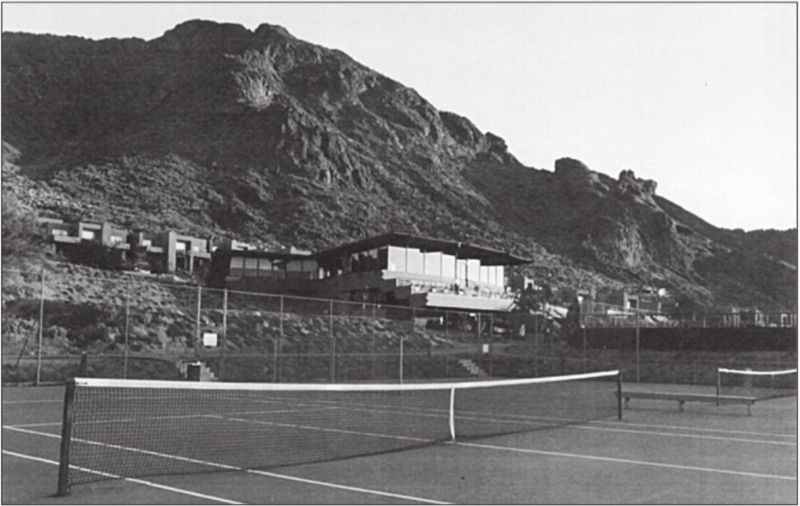
Luxurious accommodations, natural wonders, and tennis brought droves of wealthy tourists to the Valley of the Sun in the 1950s.
Forty-five years before The Sanctuary Resort on Camelback Mountain opened its doors as a luxurious paradisiacal resort, the property's story began in 1956 as the Paradise Valley Racquet Club. Created during the greatest boom in Arizona's tourist industry, this tennis club represents a historic shift in Arizona's history. It transformed from a state known for mining and agriculture to the beautiful "Valley of the Sun," inviting tourists to travel and enjoy its glamorous resorts and breathtaking natural landscape. Offering unparalleled views from Camelback Mountain, the original Paradise Valley Racquet Club is the product of a rich and complex history of tourism in the Valley.
Due to industrialization in the late 1800s and the consequential increased production rates, the middle class could afford and experience an increased selection of goods. The financial elite of society, who gained their identity from exclusively owning these goods, had to find a new way to differentiate themselves. This was when the history of tourism in the United States as we know it began, the first iteration being cultural Tourism. Those who participated in this exclusive and cost-prohibitive activity traveled to locations primarily by train and would interact with these locations as one would an exhibit in a museum. These excursions provided a newfound sense of self-worth through intangible cultural sophistication that the elite could claim as superior. As technology improved in the 1920s with the popularization of the automobile and travel infrastructure, tourism became more affordable and available for a broader class of Americans. This new population wanted to engage more with the destination, leading to the next trend in tourism: recreational tourism. Recreational tourism led travelers to engage in activities in these locations fully and popularized hunting, skiing, and dude ranching.
During World War II, Arizona and the Salt River Valley experienced their most significant tourism growth. Perhaps because of encouragement from national railroad advertisements claiming that President Roosevelt encouraged "wholesome leisure travel" to support the war effort. Additionally, "the Highway Department projected more than one million out-of-state automobiles" in 1939, a year when revenue from tourism jumped three hundred percent. Between 1945 and 1946, Arizona's hotel industry increased by more than twenty percent. By 1949 Arizona's tourism industry was a billion-dollar industry, encouraged by messages like this 1956 advertisement, "Phoenix is a new frontier, more National Parks and Monuments within a half day's drive than anywhere else in the world." All this growth represented the next stage of tourism in the American west: entertainment tourism.
This tourists' mecca is what Paradise Valley Racquet Club's famous founders would have experienced when they visited Salt River Valley in 1950. John Ireland and his wife Joanne Dru were performing a play in the Valley at this time, and it's no wonder they saw opportunity amongst the beautiful red rocks and saguaros. Partnered with Sydney Chaplin, son of cinema legend Charlie Chaplin, and the world's first tennis Grand Slam winner Don Budge, Ireland and Dru officially opened Paradise Valley Racquet Club on October 6th, 1956. The club offered members the use of five tennis courts, a cocktail lounge, a dining room, a dance floor, a swimming pool, and a recreation room, all upon 53 acres of expansive mountainside real estate. Additionally, Paradise Valley Racquet Club boasted a clubhouse designed by Hiram Hudson Benedict, who was considered to be the protégé of Frank Lloyd Wright.
The Paradise Valley Racquet Club, or "mecca for the wealthy," as it came to be called, was the main attraction for those seeking a blend of luxurious amenities and world-class tennis during their visit to the Salt River Valley. During its years in business, the Paradise Valley Racquet Club served as an elegant venue for various events: weddings, charity drives, parties, and more. It even hosted First Lady Lady Bird Johnson, wife of President Lyndon B. Johnson, to commemorate the preservation of Camelback Mountain as a scenic landscape. However, the most prominent feature through those years was its tennis courts. The Racquet Club hosted matches ranging in prestige from the local junior league to world champions Pancho Gonzalez and Lew Hoad.
The glamour of the original facility did not last forever, however. In 1962, the resort went bankrupt due to embezzlement charges and fell into disrepair. Once a site of lavish excitement and athleticism, this desert getaway location would become "a rapidly deteriorating, litter-strewn shell" rendered inoperable for years. The property eventually sold and passed through a few new renditions before becoming the Sanctuary Resort on Camelback that is seen today. The property has changed significantly over the last sixty years, with the only remaining structure of the original Paradise Valley Racquet Club being the clubhouse.
Images


Permalink Date: 1949

